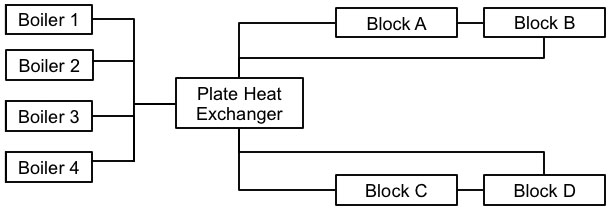

When the development was built, they installed a boiler house and a common heating system.
It has boilers that heat hot water and pumps that send that hot water out to the flats on the development.
This hot water is then used by the flats to heat their hot water and heat their radiators.
In the boiler house are 4 Buderus 100kw cascading boilers giving 400kw in total. They are connected to an insulated plate heat exchanger giving us 1 water circuit. The plate heat exchanger is connected to the 2nd water circuit that circulates around the flats. The plate heat exchanger protects the boilers from the water that is circulating around the flats.
The water from the common system comes into your flat and then as you open the valves on your radiators it fills them with hot water.
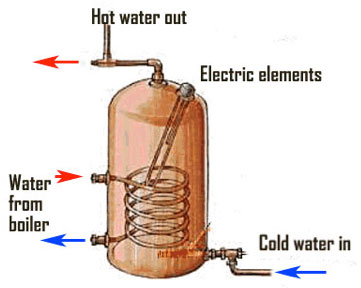
The hot water cylinder in your flat is filled with cold water first. This is probably from the cold water tank above which is filled from your mains water supply and goes into the cylinder through the "cold water in" pipe.
The common system supplies the heat to take this water from cold to hot. This hot water, heated by the boilers in the common system, goes through the coil inside your hot water cylinder (shown in the diagram) and heats the cold water up. The hot water from the common system does not come in contact with the water in your cylinder. It remains in the coil.
When you turn on your hot tap, the water that comes out is the hot water from your cylinder, not from the communal system. Each time you run the hot tap, hot water empties from the cylinder and is replaced with cold water from the mains, which then needs to be heated.
Some people also have a back up electric element called an immersion heater labelled "electric elements" in the diagram. Some people have been using both the common system and their immersion heater to heat their hot water with no controls to stop them when the water is hot.
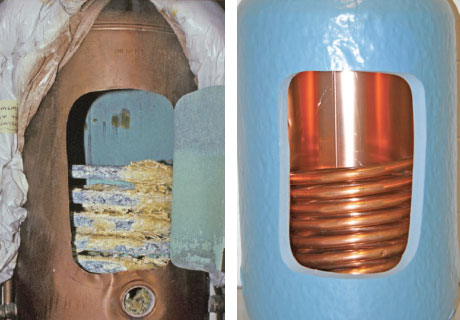
The cylinder on the left shows the heating coil covered in scale. The hot water from the common system has to pass through the coil and heat the limescale first before it heats the water that will come out of your tap. This is inefficient and leads to higher bills as more energy is needed to heat your water.
The cylinder on the right shows what a clean new one will look like.
The meter sits on the supply pipework to your flat. It measures how much water from the common system goes into your flat and it also measures what temperatures it goes in at and comes out at. This allows it to calculate how much energy has been used per flat.
When talking to flat owners and contractors, there have been some ideas mentioned that could save people money on their heating. Each flat owner can consider if they are relevant or would work for them.